Discover how Light Gauge Steel’s lightweight properties make it the perfect choice for adding floors to existing buildings in dense urban environments. Rooftop additions present unique engineering challenges that make Light Gauge Steel an ideal construction solution. When adding floors to existing buildings, the weight of the new structure is a critical factor that determines feasibility and cost. Traditional concrete construction can easily double the load on existing foundations, often requiring expensive foundation reinforcement. Light Gauge Steel structures typically weigh 40-50% less than their concrete equivalents. This weight reduction means that many existing buildings can accommodate additional floors without any foundation modification. For building owners in urban areas like Amman, this translates to significant cost savings and faster project approval. The prefabrication aspect of LGS is particularly advantageous for rooftop projects. All steel components are manufactured off-site with CNC precision, then transported to the building for rapid assembly. This minimizes disruption to existing building occupants and reduces the construction timeline from months to weeks. Urban sites often have limited crane access and restricted working hours due to neighborhood considerations. LGS components are lightweight enough to be carried manually or with small equipment, making them ideal for tight urban environments. The clean, dry assembly process also eliminates the dust, noise, and debris associated with concrete construction. At LGS Jordan, we have successfully completed numerous rooftop addition projects across Amman, including a two-story addition to an existing apartment building in the 7th Circle area. Our engineering team specializes in assessing existing structures and designing LGS solutions that maximize new floor space while respecting structural limitations.
Welcome to LGS-Jordan We are Best In Town

-
Call Us
+962 7 9092 4411
-
We are Open
Sun - Thu: 8:00 AM - 6:00 PM
-
e-mail us
info@lgsjordan.com

Speed vs. Waste: Comparing LGS to Traditional Methods
By: musmankhanlohani@gmail.com
A detailed comparison of construction timelines and material waste between Light Gauge Steel and conventional concrete/masonry construction. When evaluating construction methods, two factors consistently emerge as critical concerns: time and waste. Light Gauge Steel construction offers compelling advantages in both areas compared to traditional concrete and masonry methods. Construction speed is where LGS truly excels. A typical residential villa built with LGS can be structurally complete in 4-6 weeks, compared to 4-6 months for traditional construction. This acceleration comes from the factory-controlled prefabrication process — while site preparation is underway, all steel framing is being manufactured to precise specifications. The just-in-time delivery of pre-assembled wall panels, floor joists, and roof trusses means that on-site work focuses purely on assembly rather than fabrication. Trades can follow immediately behind the steel erection, with MEP rough-in, insulation, and cladding proceeding in rapid sequence. Material waste presents another stark contrast. Traditional construction typically wastes 10-15% of materials through cutting errors, damage, and overordering. LGS fabrication, guided by CNC machinery and optimized nesting software, reduces waste to under 2%. Every cut is precise, every component is accounted for in the production files. The environmental implications extend beyond material savings. Faster construction means shorter equipment operation periods, reduced energy consumption, and less disruption to surrounding areas. The steel itself is 100% recyclable at end of life, unlike concrete which typically ends up as construction debris. For developers and homeowners in Jordan, the choice increasingly favors LGS when project timelines and sustainability are priorities. The initial perception that LGS costs more is often reversed when accounting for reduced financing periods, lower waste disposal costs, and faster time-to-occupancy.
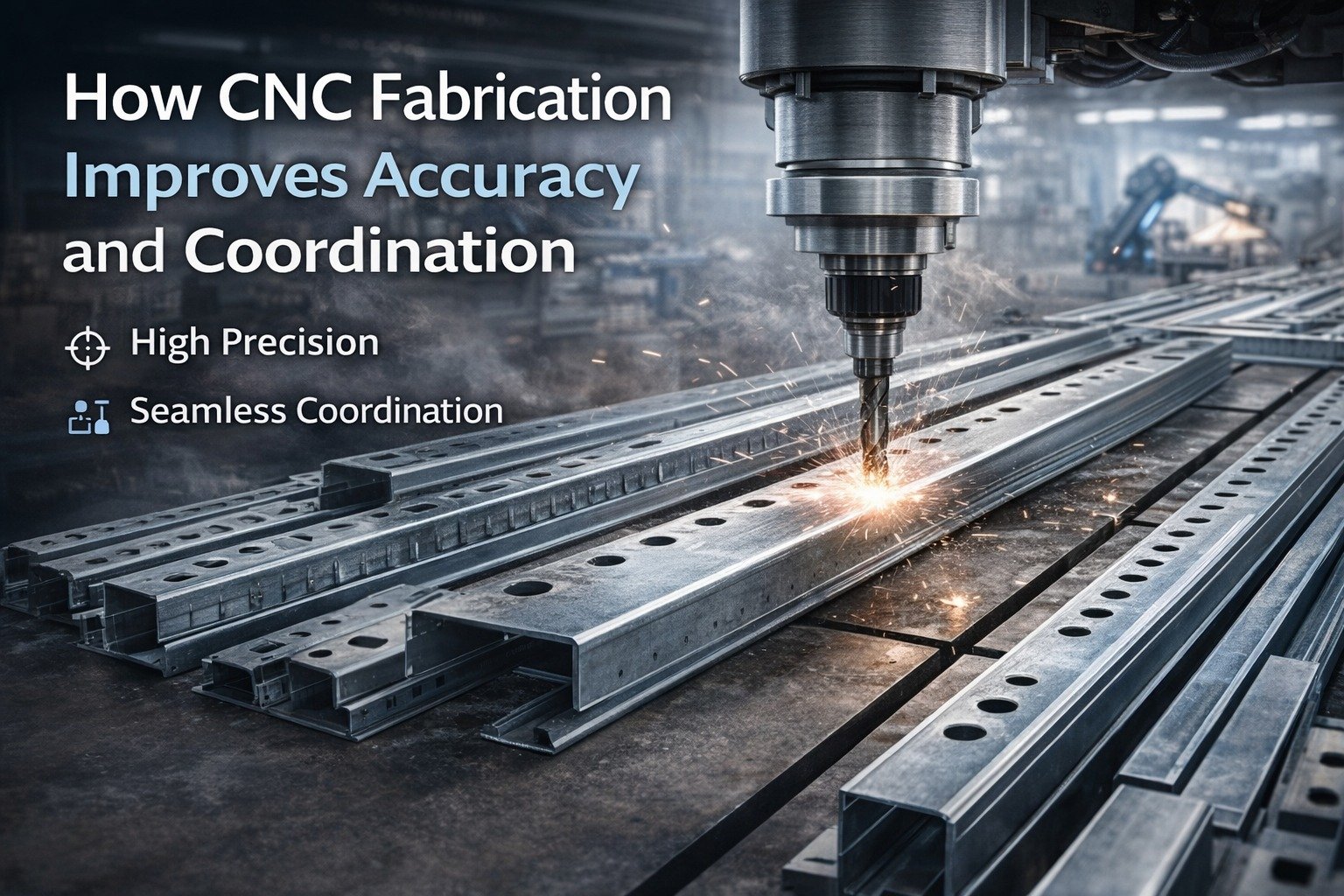
How CNC Fabrication Improves Accuracy and Coordination
By: musmankhanlohani@gmail.com
Learn how computer-controlled manufacturing eliminates site cutting errors and enables seamless coordination between trades. Computer Numerical Control (CNC) fabrication has revolutionized Light Gauge Steel construction, enabling a level of precision that was impossible with traditional on-site construction methods. At LGS Jordan, our CNC-controlled roll forming and cutting equipment produces components with tolerances of ±0.5mm — a standard that manual fabrication simply cannot match. This precision begins in the detailing phase. Our engineering team creates comprehensive 3D BIM models where every steel member, connection, and penetration is precisely located. These models generate production files that drive our CNC machinery directly — eliminating the interpretation errors that occur when workers read traditional drawings. The accuracy advantage compounds as the structure is assembled. When every stud is exactly the specified length, wall panels align perfectly. When every joist is punched at precisely the right locations, MEP trades can install services without field modifications. When roof trusses match their designed geometry, roofing installation proceeds without adjustment. Coordination between trades improves dramatically with CNC-fabricated LGS. The 3D model serves as a coordination tool where electrical, plumbing, and HVAC penetrations are pre-planned and pre-punched into steel members. On-site conflicts — a common source of delays and rework in traditional construction — are virtually eliminated. For architects and designers, CNC fabrication enables complex geometries that would be cost-prohibitive with manual methods. Curved walls, non-orthogonal layouts, and intricate roof forms become feasible when the manufacturing process can handle the complexity without added labor cost.
Recent Post

Why LGS Is Ideal for Rooftop Additions in Urban Areas
January 25, 2022Speed vs. Waste: Comparing LGS to Traditional Methods
January 1, 2022